Author
The #1 AI-powered authoring tool on the market

Factory
Custom e-learning content factory

Skills
Comprehensive power skills course catalog

LMS
All-in-one LMS platform with AI

Engage
App for managing frontline teams

Game
Gamification app for business
FEATURES

AINew
Unlock your full potential and speed up course creation with artificial intelligence.

Accessibility
Automatically meet accessibility guidelines—without sacrificing interactivity!

Interactivity
Boost engagement with interactive, ready-to-use activities that make learning fun.

Course Creation
Reduce the time it takes to create your e-learning courses with our authoring tool.

Distribution
We offer you different distribution options, so that nothing can stop you.

SCORM
Publish your course in SCORM format and share it on any LMS.


SERVICES

Instrucional Design
Surprise your students with multimedia and interactive content.

Custom Courses
We create e-learning courses for you—tailored to your needs and hassle-free!

Virtual Reality
Turn learning into an immersive experience.

Custom Avatars
Give your courses and videos a unique touch with personalized avatars.

Audiovisual FactoryNew
Turn training into something dynamic and visual with engaging videos.
CATALOG
Course catalog
Over 600 skills and competency courses to help you adapt to your team's needs.

Microsoft Copilot AcademyNew
Your professionals will learn how to apply Copilot AI to key processes within your organization.
Artificial Intelligence Academy
Train your teams in the practical use of AI to boost productivity and innovation in your company.

Cybersecurity Academy
Capacita a tu empresa con el catálogo más completo en seguridad digital corporativa.
FEATURES

Quizzes & Games
Turn your training into an engaging Q&A game.

Challenges & Competitions
Enhance learning through friendly peer challenges.
Rewards & Incentives
Motivate employees with points, levels, and leaderboards.
Social & Collaborative
Strengthen team connections with interactive social dynamics.

KPIs & Analytics
Track and optimize your training initiatives instantly and effortlessly.


Use cases
Choose the solution that best fits your needs

Industries
Solutions for all types of industries
USE CASES
Onboarding
Facilitate the onboarding process, productivity and engagement of your new employees.
Upskilling
Boost your team's skills and prepare them for the challenges of the future with upskilling.
Microlearning
Discover all the advantages of microlearning and boost your training results.
Gamification
Enjoy addictive training that will get your professionals hooked.

Internal Communication
Improve communication in your company and enjoy an aligned and committed team.

Mobile learning
Agile, flexible, and interactive learning—built for today’s digital-first workforce.
INDUSTRIES

Banking and financial services
Training in compliance, cybersecurity, customer service, and key skills development.

Pharmaceuticals and healthcare
Digital onboarding, regulatory updates, and ongoing training for healthcare staff.

Retail and consumer
Agile and scalable training for in-store, operational, and customer service teams.

Industry and manufacturing
Training in processes, safety, and corporate culture for distributed teams.

Education and training
Digital solutions for training centers, internal academies, and corporate universities.

Technology and telecommunications
Development of technical talent, digital skills, and upskilling and reskilling programs.
CLIENTS

MAPFRE
How MAPFRE turn e-learning into sales with isEazy

Pepco
A personalised learning experience for a growing team.

BBVA
Digitisation and creation of high quality e-learning content.

Shiseido
We increase the engagement of the training with a social and gamified app.

Telefónica
Large-scale reskilling for the company's digital transformation.

Vodafone
A personalised learning experience for a growing team.
More than 1,000 companies already rely on isEazy.





MEET ISEAZY

News
Find out the latest news about isEazy: press releases, partnerships, updates...

Contact
Leave us your personal details and we will contact you as soon as possible.
About isEazyNew
Find out more about our company.
Careers
We are looking for the best talent, join our team!

Partners
Become our partner and grow your business.
INTERESTING RESOURCES

Blog
The best content on e-learning: trends, tools and key strategies.
Whitepapers
Gain valuable insights and stay ahead of industry trends.
Product releases
The latest news and releases of our e-learning products and solutions.

Glossary
Definitions of the most commonly used terms and key industry concepts.
Guides
Discover the best step-by-step tips and tricks to optimize your L&D strategy.
Webinars
Video sessions on our products, trends and more

Comparatives
Compare e-learning solutions available on the market and choose the most suitable one.
April 1, 2026
Gamification at Work: The Complete Guide to Boosting Training Through Games

CONTENT CREATED BY:

Table of contents
Keeping employees motivated and engaged can be a constant challenge for any HR leader. Fortunately, in recent years a powerful tool has been gaining ground to address this issue: gamification.
By integrating game elements into various aspects of working life, companies can increase employee participation, improve performance and foster a more collaborative and creative work environment. In fact, the gamification market is expected to achieve an annual growth rate of 7.67% through to 2027. Want to know why more and more companies are incorporating gamification into their initiatives — especially those related to training? Read on to find out.
What is gamification at work and what is it used for?
Imagine your employees earning points and incentives for completing workplace safety training — wouldn’t they be more motivated to participate? This is the essence of gamification in companies: applying game mechanics and elements to corporate processes such as training, onboarding, internal communication, sales or the adoption of new tools.
The concept of gamification was popularised by Jane McGonigal in her book Reality is Broken and has been developed by industry experts such as Karl Kapp, who emphasises its importance in the context of corporate learning. According to Kapp, gamification is not just about adding game elements to content, but about creating meaningful experiences that motivate people to act.
Why do companies use gamification in training?
Because traditional training often struggles with low completion rates, passive consumption and poor knowledge retention. Gamification solves this by introducing challenge, feedback and progress — the three ingredients that make learning stick.
Research consistently shows that gamified training programmes generate higher engagement. According to TalentLMS, 89% of employees say they would be more productive if their work were more game-like, and 83% feel more motivated when training includes gamification elements.
Technical requirements to scale gamification in your company
Before choosing a tool, make sure your technical infrastructure is ready to support a scalable gamification strategy. The table below outlines the key integration capabilities to look for:
| Capability | What it enables | Why it matters |
|---|---|---|
| LMS integration (SCORM, xAPI, cmi5) | Connect gamification with training platforms | Enables scalable, centralised learning |
| SSO (SAML, OpenID) | Single sign-on without multiple logins | Improves adoption and user experience |
| Data tracking (analytics) | Measure participation, progress and results | Demonstrates impact and optimises strategy |
| Mobile compatibility | Access from any device | Essential for frontline teams and mobile learning |
Need more reasons? Here are some statistics:
How to increase the impact of your training with gamification
To get the most out of gamification, it is essential to adopt certain key strategies. Here are some fundamental tips and steps:
- Define clear objectives: What do you want to achieve with the training? Set specific, measurable goals so you can evaluate the success of the initiative.
- Choose the right game mechanic: There are different game mechanics you can use — such as points or badges. Choose those that best fit your objectives and training content.
- Use appropriate gamification elements: Leaderboards, challenges, rewards and interactive quizzes can all make training more engaging. Choose those that suit the type of content and your target audience.
- Integrate gamification progressively: Don’t try to gamify everything at once. Start with a specific area and expand as you see positive results.
- Measure and adjust: Use data and analytics to evaluate the effectiveness of your gamification strategy and adjust it over time.
Most common gamification elements
Leaderboards
Leaderboards make results visible and create friendly competition. They show rankings based on points, completions or challenges met, motivating employees to stay active and strive to improve.
Badges
Badges are visual rewards given for completing objectives or reaching specific milestones. They serve as recognition and as a record of progress, and can be shared to reinforce a culture of achievement.
Points and rewards
Points are the most basic currency of gamification. They reward actions — watching a video, completing a module, answering correctly — and can accumulate towards prizes, levels or recognition.
Quizzes and multimedia questions
Interactive questions check knowledge retention in real time. When combined with images, audio or video, they become far more engaging than a traditional test.
Levels
Levels provide a sense of progression. Employees can see how far they have come and what lies ahead, which sustains motivation over time and encourages continued participation.

Gamification activities you can use in your training
Beyond the elements mentioned above, there are specific gamification activities you can use to energise your training programme and increase its impact.
Text-based questions
This type of activity gives your employees the opportunity to answer theory-based questions. The most common are multiple-choice (ABCD), where a question is asked with between two and four answer options. Other text-based questions include true or false, where participants simply decide whether a statement is accurate.
Audiovisual questions
This type of interactive activity includes audio or video clips that employees must listen to or watch before answering the associated question. This format not only assesses knowledge retention, but also introduces greater dynamism into the learning experience.
Image-based questions
These present images alongside the question, making the content more visual and immediate. They are especially useful for process recognition, product identification or contextual scenarios where visual cues are key.
Hotspots
Hotspots are interactive elements that allow employees to click on specific points within an image to reveal additional information or answer questions. They are particularly effective for technical content, equipment training or spatial recognition tasks.
Free text
Free-text questions require employees to write their own answers, encouraging deeper thinking and personalised expression. They work well for reflective tasks or open-ended scenarios.

How to measure the ROI of gamification
Base formula:
ROI = (business impact – implementation cost) / implementation cost
Example indicators to track:
- Reduction in errors → -20%
- Increase in sales → +15%
- Training time saved → -30%
Types of gamification: what to choose
Intrinsic vs extrinsic
| Type | When to use | Risk |
|---|---|---|
| Extrinsic (points, prizes) | Onboarding, short campaigns | Dependency |
| Intrinsic (challenge, progress) | Continuous training | Harder to design |
4 gamification tools for companies
To ensure the success of gamification in the corporate environment — especially in training — it is crucial to choose the right tools. Here are some of the most widely used gamification tools:
- AhaSlides: A tool that allows you to create games, surveys, quizzes and competitions simply, both in the classroom and at home. It offers multiple content creation options, such as quizzes with multiple-choice, text or image answers.
- Plickers: A gamification app with augmented reality that lets you scan unique cards held up by participants to collect responses in real time. Especially useful for in-person sessions where not all employees have a device.
- Symbaloo: An app that combines gamification with visual organisation. It allows you to create personalised boards by collecting, organising and accessing resources from a single platform, making it ideal for structuring gamified learning itineraries.
- isEazy Game: A gamification platform specifically designed for corporate training. It enables you to transform any content into challenges, games and interactive experiences with advanced tracking capabilities. Unlike the other tools, it is built for scalability and integration with your existing LMS.
Comparison of gamification tools for companies
Below is a list of the 4 best gamification platforms in 2026, carefully selected to cover different business needs, with current ratings to make it much easier to choose the one that suits you best:
Features
Advantages
- Creation of games (individual, team vs. team, multiplayer).
- Quizzes.
- Challenges and competitions.
- Leaderboards, levels, and achievements (rewards and prizes).
- Dashboard or control panel (participation, access, progress, usage metrics, activities, etc.).
- Tracking reports and analytics by knowledge categories.
- Social and collaborative app (chat, notifications, comments, collaboration, likes).
- Customization (colors, logos, avatars, icons, corporate branding).
- All types of questions, audio, videos, images, etc.
- Mobile access.
- Real-time feedback.
- Easy to use.
- Smart search engine.
- Client area and support.
- Multiple languages (more than 23 languages).
- Multiple use cases (training, sales, corporate culture).
Features
- Creation of games (individual, team vs. team, multiplayer).
- Quizzes.
- Challenges and competitions.
- Leaderboards, levels, and achievements (rewards and prizes).
- Dashboard or control panel (participation, access, progress, usage metrics, activities, etc.).
- Tracking reports and analytics by knowledge categories.
- Social and collaborative app (chat, notifications, comments, collaboration, likes).
Advantages
- Customization (colors, logos, avatars, icons, corporate branding).
- All types of questions, audio, videos, images, etc.
- Mobile access.
- Real-time feedback.
- Easy to use.
- Smart search engine.
- Client area and support.
- Multiple languages (more than 23 languages).
- Multiple use cases (training, sales, corporate culture).
Features
Advantages
- Creation of different types of tests.
- Creation of individual or group Kahoot-style quizzes.
- Leaderboards and podium rankings.
- Feature to clone or duplicate content.
- Social and collaborative area (chat and news).
- AI assistant (Pro and Pro-Max accounts only).
- You can access ready-made Kahoot-style quizzes shared by others.
- Administrator or creator account, with access to quizzes via code and app download.
- All types of questions, videos, and images.
- Multiple languages available.
- Easy to use.
- Multiple use cases (training, sales, internal communications, customer service).
Features
- Creation of different types of tests.
- Creation of individual or group Kahoot-style quizzes.
- Leaderboards and podium rankings.
- Feature to clone or duplicate content.
- Social and collaborative area (chat and news).
- AI assistant (Pro and Pro-Max accounts only).
Advantages
- You can access ready-made Kahoot-style quizzes shared by others.
- Administrator or creator account, with access to quizzes via code and app download.
- All types of questions, videos, and images.
- Multiple languages available.
- Easy to use.
- Multiple use cases (training, sales, internal communications, customer service).

Features
Advantages
Pricing
- Onboarding based on continuous learning and gamification.
- Creation of personalized onboarding paths or missions.
- Real-time progress tracking and analytics.
- Interactive elements to enhance engagement.
- Integration with LMS and other corporate systems.
- Pre-onboarding checklists.
- Improves motivation and engagement.
- AI-powered knowledge update quizzes.
- Provides real-time data to assess performance and engagement.
- Focused on continuous development throughout onboarding.
- Interactivity and dynamism in onboarding processes.
It is necessary to fill out a form to obtain pricing.
Features
- Onboarding based on continuous learning and gamification.
- Creation of personalized onboarding paths or missions.
- Real-time progress tracking and analytics.
- Interactive elements to enhance engagement.
- Integration with LMS and other corporate systems.
- Pre-onboarding checklists.
Advantages
- Improves motivation and engagement.
- AI-powered knowledge update quizzes.
- Provides real-time data to assess performance and engagement.
- Focused on continuous development throughout onboarding.
- Interactivity and dynamism in onboarding processes.
Pricing
It is necessary to fill out a form to obtain pricing.
How to choose a gamification tool: decision checklist
| Criterion | What to evaluate | Why it matters |
|---|---|---|
| Type of use | Do you need a tool for one-off sessions or an ongoing programme? | Determines whether you need a simple solution or a long-term scalable platform. |
| Device | Will your users access from mobile, desktop or both? | Mobile access is key to adoption, especially for distributed or frontline teams. |
| Measurement | Do you want to measure participation only or also business impact? | Without analytics you cannot demonstrate ROI or optimise the strategy. |
| Integrations | Does it need to integrate with your LMS, content or internal systems? | Avoids silos and improves the user experience. |
| Management | Who will manage it: L&D, HR, managers or IT? | Affects ease of use and the team's operational workload. |
| Operational effort | How much work is required to launch new dynamics? | If the effort is high, adoption and continuity will be low. |
Motivation, productivity and more: The advantages of gamification for companies
What makes gamification so special and effective in an organisation is that it actively involves employees, fostering a sense of belonging and identity. Here are some of the key benefits:
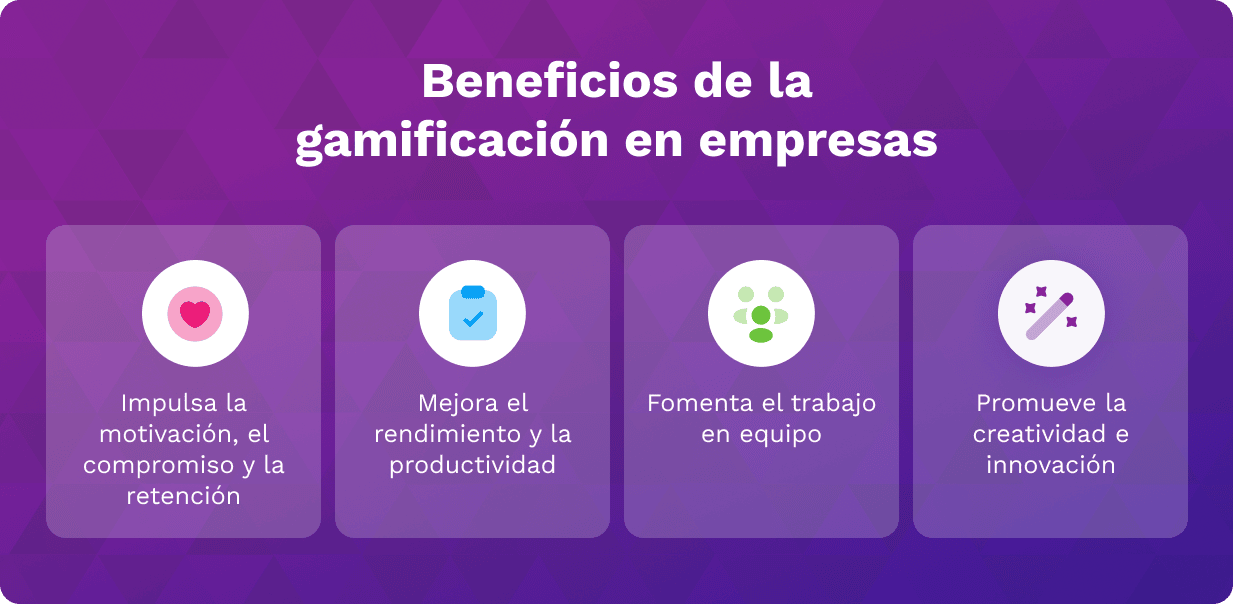
Boosts motivation, engagement and retention
Through elements such as challenges and rewards, gamification actively involves employees. It creates a fun and exciting environment that motivates employees to participate and push their limits, increasing commitment to the training process. In fact, 95% of employees enjoy using gamified systems, making gamification a powerful tool for increasing employee retention. The interactive and participatory approach of gamification captures employee attention and, in turn, reduces staff turnover.
Improves performance and productivity
Gamification significantly boosts employee performance and productivity. By motivating employees through challenges and rewards, companies can increase their workforce’s efficiency and effectiveness. In addition, gamification provides immediate feedback that helps employees identify areas for improvement, enabling them to work more effectively.
Encourages teamwork
Elements such as team challenges and collaborative leaderboards encourage employees to work together towards common goals. This improves team cohesion and collaboration, which in turn increases overall productivity and performance.
Promotes creativity and innovation
By creating a safe environment where employees can experiment with new ideas and solutions, gamification fosters creativity and innovation within companies. Employees are motivated to find novel and effective approaches to solving problems, which can lead to significant improvements in products, services and processes.
Real examples of gamification in companies
Companies that embrace gamification for employee training don’t just do so to strengthen commitment to the organisation — they also do it to maximise productivity, improve skills and reinforce their corporate culture. Here are some success stories to inspire you:
How we helped Clarel train the professionals across its more than 1,000 points of sale
With more than 1,000 points of sale in Spain, Clarel is a brand specialising in beauty, personal care and wellbeing. Its goal was to turn its entire sales team into experts in its product catalogue and brand news. How did it achieve this? With the help of isEazy, through agile, fun and flexible training specially designed for its team.
Thanks to gamification mechanics, Clarel was able to easily assess training results among its employees, all while creating an enjoyable and stimulating learning experience. Discover the full success story.
How we boosted training engagement at Shiseido with gamification
With the help of isEazy, cosmetics firm Shiseido has achieved excellent results by applying gamification to training. Through a social and gamified app, it has managed to increase training engagement and achieve more than 90% content retention. In addition, it increased employee commitment by unifying training and gamification with formats such as video tutorials, challenges and games. Find out more about this success story.
100% mobile training to upskill the Bridgestone distribution network
Bridgestone, the world’s leading tyre manufacturer, needed to train its entire Latin America distribution network in a practical, effective and flexible way. With isEazy, it developed a fully mobile and gamified environment that allowed its team to access training from anywhere and at any time. Read the full case study.
The future of gamification in companies
Gamification is evolving rapidly. Emerging trends point towards increasingly personalised experiences driven by artificial intelligence, more sophisticated integration with LMS platforms, and a greater focus on measuring real business impact rather than just participation. Companies that embrace gamification today are building the foundation for a more engaged, productive and future-ready workforce.
Gamify your training and multiply its results by 10 with isEazy Game
Now you know how gamification works and what results it can generate. If you want a tool specifically designed for corporate training — one that lets you create challenges, interactive games and engaging dynamics with full analytics — discover isEazy Game and request your demo today.
Frequently Asked Questions about Gamification at Work
How does gamification improve learning and which tool stands out in this field?
Gamification improves learning by increasing knowledge retention and boosting motivation. isEazy Game is a standout tool in this field, turning training into a unique and stimulating experience through effective gamification dynamics such as challenges, games, quests, levels and leaderboards. This tool helps significantly improve training outcomes by making learning more engaging and participatory.
What benefits does gamification offer on e-learning platforms?
Gamification incorporates elements such as rewards, challenges and recognition to motivate users to complete courses. This increases engagement and helps improve knowledge retention. Platforms that offer gamification, such as isEazy LMS, transform learning into an attractive and dynamic experience.
What are the main benefits of gamification in companies?
The main benefits of gamification include:
- Increased motivation and engagement by up to 48%.
- Improved performance and productivity thanks to immediate feedback.
- Encouraged teamwork and collaboration through shared objectives.
- Promotion of creativity and innovation by experimenting with novel solutions.
How do you design an effective gamification strategy?
For a gamification strategy to succeed, several key aspects must be considered:
- Objectives: Define specific goals you want to achieve, such as increasing participation or improving learning.
- Target audience: Analyse the characteristics, interests and needs of users to create engaging dynamics.
- Design: Ensure the experience is intuitive and motivating, avoiding unnecessary complexity.
- Feedback: Implement constant feedback systems to guide and improve participants’ performance.
How is gamification applied to learning and skills development?
Gamification transforms traditional learning processes into interactive experiences, improving knowledge retention and skills development. Key applications include:
- Interactive learning: Makes content more engaging and easier to remember.
- Motivation and engagement: Increases participation through challenges and rewards.
- Soft skills development: Improves competencies such as teamwork, problem-solving and effective communication.
- Formative assessment: Provides continuous feedback, enabling users to identify areas for improvement.
How can instructional design models be integrated with current e-learning trends like gamification?
Instructional design models can serve as a foundation for incorporating gamification elements, structuring activities and content so that these innovative elements reinforce learning objectives. It is possible to include rewards, leaderboards, badges and more, offering learners positive reinforcement and motivating them to continue learning.
What is gamification and what are its fundamental principles?
Gamification is a strategy that uses game mechanics and elements — such as competition, achievements, rewards and narrative — in non-gaming contexts like education or the corporate environment. Its goal is to improve motivation, participation and engagement. For it to work effectively, three key principles come into play:
- Mechanics: Basic elements such as rules, levels, avatars and points systems.
- Dynamics: Aspects that spark interest and motivate, such as challenges and rewards.
- Aesthetics: Friendly, intuitive and attractive design that improves the user experience.
What makes isEazy Game the ideal tool for gamification?
isEazy Game transforms learning into an interactive and enjoyable experience. Its intuitive design makes it easy to turn training content into simple dynamics, challenges and interactive games, maximising knowledge retention and employee motivation. It also integrates advanced tracking and analytics tools to measure learning progress and impact.

Transform your training into a unique experience
Discover how isEazy Game can transform your training content into attractive and effective games





Transform your training into a unique experience
Discover how isEazy Game can transform your training content into attractive and effective games
Discover more e-learning guides