Author
The #1 AI-powered authoring tool on the market

Factory
Custom e-learning content factory

Skills
Comprehensive power skills course catalog

LMS
All-in-one LMS platform with AI

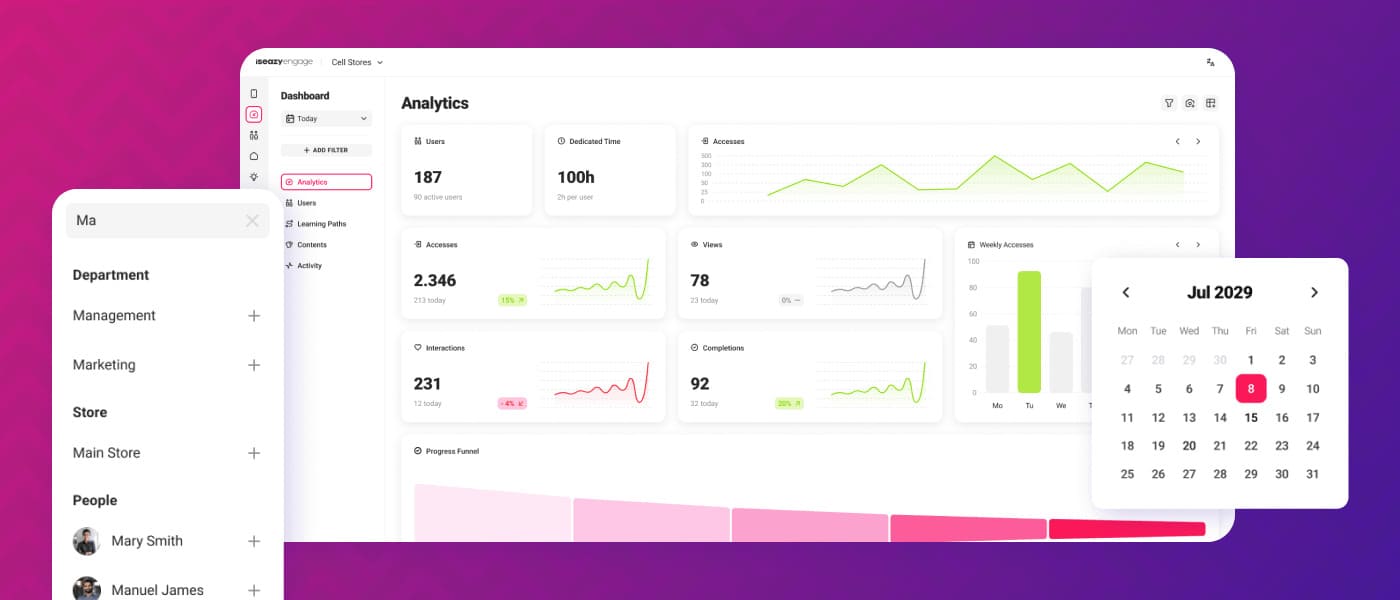
Engage
App for managing frontline teams

Game
Gamification app for business
FEATURES

AINew
Unlock your full potential and speed up course creation with artificial intelligence.

Accessibility
Automatically meet accessibility guidelines—without sacrificing interactivity!

Interactivity
Boost engagement with interactive, ready-to-use activities that make learning fun.

Course Creation
Reduce the time it takes to create your e-learning courses with our authoring tool.

Distribution
We offer you different distribution options, so that nothing can stop you.

SCORM
Publish your course in SCORM format and share it on any LMS.


SERVICES

Instrucional Design
Surprise your students with multimedia and interactive content.

Custom Courses
We create e-learning courses for you—tailored to your needs and hassle-free!

Virtual Reality
Turn learning into an immersive experience.

Custom Avatars
Give your courses and videos a unique touch with personalized avatars.

Audiovisual FactoryNew
Turn training into something dynamic and visual with engaging videos.
CATALOG
Course catalog
Over 600 skills and competency courses to help you adapt to your team's needs.

Microsoft Copilot AcademyNew
Your professionals will learn how to apply Copilot AI to key processes within your organization.
Artificial Intelligence Academy
Train your teams in the practical use of AI to boost productivity and innovation in your company.

Cybersecurity Academy
Capacita a tu empresa con el catálogo más completo en seguridad digital corporativa.
FEATURES

Quizzes & Games
Turn your training into an engaging Q&A game.

Challenges & Competitions
Enhance learning through friendly peer challenges.
Rewards & Incentives
Motivate employees with points, levels, and leaderboards.
Social & Collaborative
Strengthen team connections with interactive social dynamics.

KPIs & Analytics
Track and optimize your training initiatives instantly and effortlessly.


Use cases
Choose the solution that best fits your needs

Industries
Solutions for all types of industries
USE CASES
Onboarding
Facilitate the onboarding process, productivity and engagement of your new employees.
Upskilling
Boost your team's skills and prepare them for the challenges of the future with upskilling.
Microlearning
Discover all the advantages of microlearning and boost your training results.
Gamification
Enjoy addictive training that will get your professionals hooked.

Internal Communication
Improve communication in your company and enjoy an aligned and committed team.

Mobile learning
Agile, flexible, and interactive learning—built for today’s digital-first workforce.
INDUSTRIES

Banking and financial services
Training in compliance, cybersecurity, customer service, and key skills development.

Pharmaceuticals and healthcare
Digital onboarding, regulatory updates, and ongoing training for healthcare staff.

Retail and consumer
Agile and scalable training for in-store, operational, and customer service teams.

Industry and manufacturing
Training in processes, safety, and corporate culture for distributed teams.

Education and training
Digital solutions for training centers, internal academies, and corporate universities.

Technology and telecommunications
Development of technical talent, digital skills, and upskilling and reskilling programs.
CLIENTS

MAPFRE
How MAPFRE turn e-learning into sales with isEazy

Pepco
A personalised learning experience for a growing team.

BBVA
Digitisation and creation of high quality e-learning content.

Shiseido
We increase the engagement of the training with a social and gamified app.

Telefónica
Large-scale reskilling for the company's digital transformation.

Vodafone
A personalised learning experience for a growing team.
More than 1,000 companies already rely on isEazy.





MEET ISEAZY

News
Find out the latest news about isEazy: press releases, partnerships, updates...

Contact
Leave us your personal details and we will contact you as soon as possible.
About isEazyNew
Find out more about our company.
Careers
We are looking for the best talent, join our team!

Partners
Become our partner and grow your business.
INTERESTING RESOURCES

Blog
The best content on e-learning: trends, tools and key strategies.
Whitepapers
Gain valuable insights and stay ahead of industry trends.
Product releases
The latest news and releases of our e-learning products and solutions.

Glossary
Definitions of the most commonly used terms and key industry concepts.
Guides
Discover the best step-by-step tips and tricks to optimize your L&D strategy.
Webinars
Video sessions on our products, trends and more

Comparatives
Compare e-learning solutions available on the market and choose the most suitable one.

September 18, 2024
AI avatars in corporate training: how to create professional videos without recording or editing

CONTENT CREATED BY:
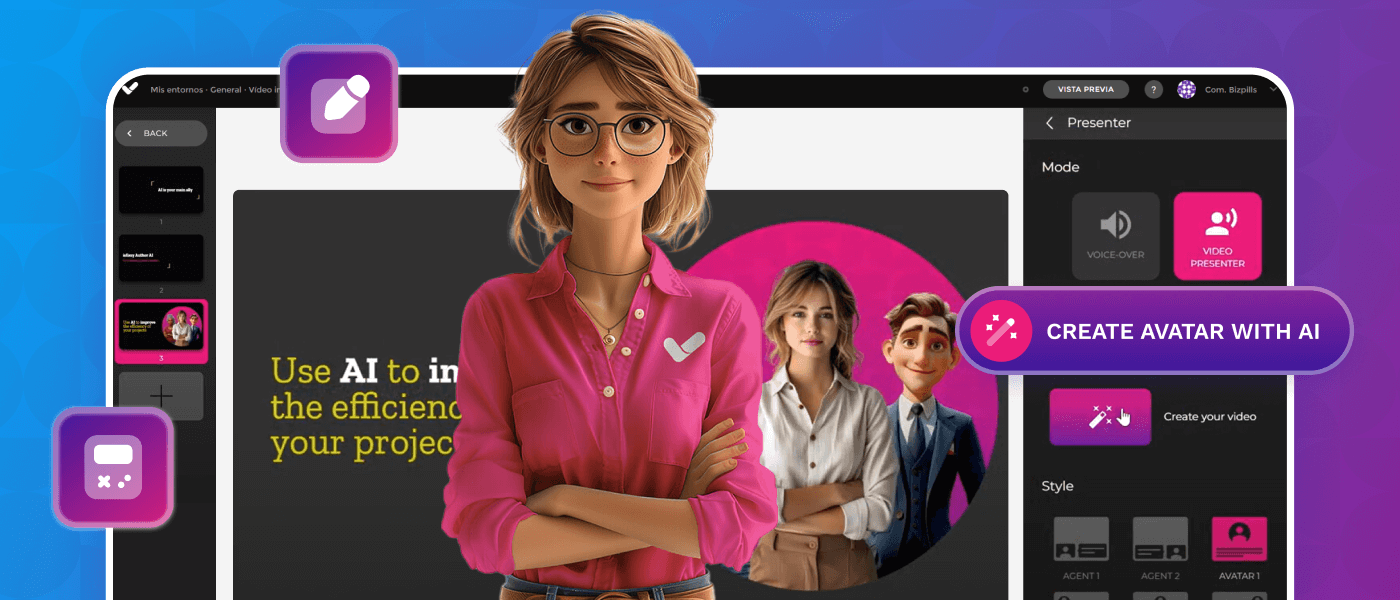
Table of contents
AI avatars are no longer a technological experiment. They are a real solution for companies that need to produce training content consistently, quickly, and at scale.
During years, creating a video with a presenter meant coordinating schedules, recording sessions, editing, lighting, voice-over, legal review… weeks of work for a single asset. And when the content became outdated, the entire process had to be repeated.
Today, an AI-powered avatar can turn a script into a professional video in a matter of minutes. But the relevant question is not technological. It’s strategic: In which cases does it make sense to use AI avatars in corporate training?
It makes sense when training is continuous, when content needs to be updated frequently, when you need to scale into multiple languages, or when you produce video on a recurring basis without relying on constant recordings. In those scenarios, an AI avatar is not just an aesthetic improvement — it’s an operational decision that reduces time, costs, and friction.
What exactly are AI avatars and why are they growing in e-learning
An AI avatar is a virtual presenter generated through artificial intelligence capable of:
- Synchronizing voice and lip movement with precision
- Adapting tone and emotion
- Generating video from text
- Localizing content into multiple languages
In corporate training, this has a direct impact on three critical variables: speed, cost, and message consistency.
Companies no longer produce a single course per year. They produce ongoing microcontent: regulatory updates, product launches, process changes, continuous onboarding. The volume has increased, but resources have not always grown at the same pace.
That’s where AI avatars begin to make operational sense. The difference compared to traditional recording starts with:
| Criteria | Traditional Recording | AI Avatar Integrated into Authoring Tool |
|---|---|---|
| Production time | 2–4 weeks | Minutes |
| Cost per video | High (equipment, filming, editing) | Low or marginal |
| SCORM integration | Manual or post-production | Native |
| Content updates | Requires new recording | Direct editing within the course |
| Multilingual scalability | Costly and slow | Fast and automated |
| Instructional control | Limited to exported video | Full control within the course |
How to create videos with AI avatars inside an e-learning course
One of the key differences when evaluating AI avatar solutions is not the visual quality of the presenter, but how it integrates into the learning process. Generating a standalone video is not the same as producing a resource that becomes a real part of a course, with tracking, pedagogical coherence, and LMS compatibility.
In the case of isEazy Author, avatars are embedded directly into the instructional workflow. It is not an external marketing tool, but an integrated training resource.
From any video module, you can activate AI Video Studio and follow a simple process:
- Select the avatar (3D, comic, or realistic style).
- Add the script you want narrated.
- Configure voice and tone.
- Generate the video automatically.
The result is an element fully integrated into your SCORM course, with tracking, reporting, and instructional consistency. And that completely changes the approach compared to platforms focused exclusively on commercial video production.
Technical specifications you should evaluate before choosing an AI avatar solution
When a company evaluates AI avatar tools, it is usually looking for more than just “a good-looking video.”
It needs technical and operational guarantees. In a B2B training environment, you should analyze:
- Compatibility with SCORM and corporate LMS platforms.
- True multilingual capabilities.
- Generation speed and usage limits.
- Corporate customization options.
- Consent management in the case of digital twins.
- Control over content updates and reuse.
In many cases, the issue is not the visual quality of the avatar. It is its real integration within the learning ecosystem.
Are AI avatars always the best option?
No. There are scenarios where a video recorded with a real person delivers an emotional component that artificial intelligence does not yet replicate with the same depth.
If you need complex storytelling, high emotional intensity, or cinematic production, an avatar does not fully replace that format.
But if you need:
- Clear and structured communication.
- International scalability.
- Frequent updates.
- Reduced production time.
Then you are looking at a strategic tool. We create custom corporate characters that you can include in your catalog and reuse as often as needed. To learn more, contact us.

Custom avatars and corporate digital twins
A strong differentiator is the ability to create a custom avatar or digital twin beyond standard catalog options. Companies that want to reinforce internal leadership can create an avatar of the CEO or other key figures with formal consent. This allows institutional messages to be delivered with a greater sense of proximity and authority, without relying on schedules or recurring recording sessions.
In addition, visual customization (corporate colors, wardrobe, brand identity) strengthens brand consistency across every training asset.
Strategic comparison: authoring tool vs. external AI video platform
Many AI video platforms are optimized to generate quick assets for marketing, commercial communication, or promotional content. Their primary focus is visual production.
In corporate training, the critical factor is not just generating a video, but integrating it into a structured learning process. When the objective is to create measurable and scalable courses, additional factors come into play:
- Ensuring the video is part of a pedagogical sequence.
- Allowing the LMS to track progress and completion.
- Enabling content to be updated without rebuilding the entire course.
- Maintaining production that is recurring and sustainable over time.
That is why the key difference lies in the level of integration within the learning ecosystem. In a corporate environment, value is not measured solely by the generated video, but by how that resource connects to learning objectives, tracking, and continuous improvement.
Conclusion
AI avatars have evolved from an innovative resource into an operational tool. In environments where training is continuous and content requires frequent updates, agility is no longer a competitive advantage — it has become a basic requirement. The ability to produce, modify, and scale video without relying on traditional audiovisual processes fundamentally changes how training teams operate.
The question is no longer whether artificial intelligence can generate videos. The real question is whether your current training production system is prepared for the speed demanded by today’s business environment.
Creating outstanding e-learning courses with the help of AI is now easier than ever. Request a demo and discover everything you can achieve with isEazy Author.
Frequently Asked Questions About AI in Corporate Training
What real advantages do AI avatars offer compared to traditional video recording?
The main advantage is operational efficiency. With an AI avatar, you can generate and update videos in a matter of minutes, without coordinating filming crews or editing teams. This dramatically reduces production timelines and makes it easier to keep training content consistently up to date. In multinational environments, localization into multiple languages is also significantly simpler compared to traditional recording.
Can AI avatars be integrated into any LMS?
It depends on the tool being used. In solutions integrated within a SCORM-compatible authoring tool, avatar-generated videos are embedded directly into the course and can be tracked by the LMS like any other learning asset. However, if you use an external video platform, you will typically need to export and manually integrate the content.
Is it safe to create a digital twin of a CEO or employee?
Yes, provided there is explicit consent and a proper authorization workflow in place. In corporate environments, it is essential that the creation of a custom avatar or digital twin is governed by clear internal agreements regarding image rights and the scope of the generated content.
Do AI avatars actually improve learner engagement?
Several corporate projects report higher completion and retention rates when content includes virtual presenters compared to static videos or narrated slides. The impact ultimately depends on instructional design, but the visual component and the sense of “human presence” tend to positively influence sustained attention.
When is it not advisable to use AI avatars in training?
AI avatars are not ideal when the content requires strong emotional depth, complex interpretation, or advanced storytelling. In those cases, videos featuring real people may provide greater authenticity. AI avatars are particularly effective for technical training, onboarding, compliance, and frequently updated content.
Featured articles



WEBINAR ONDEMAND
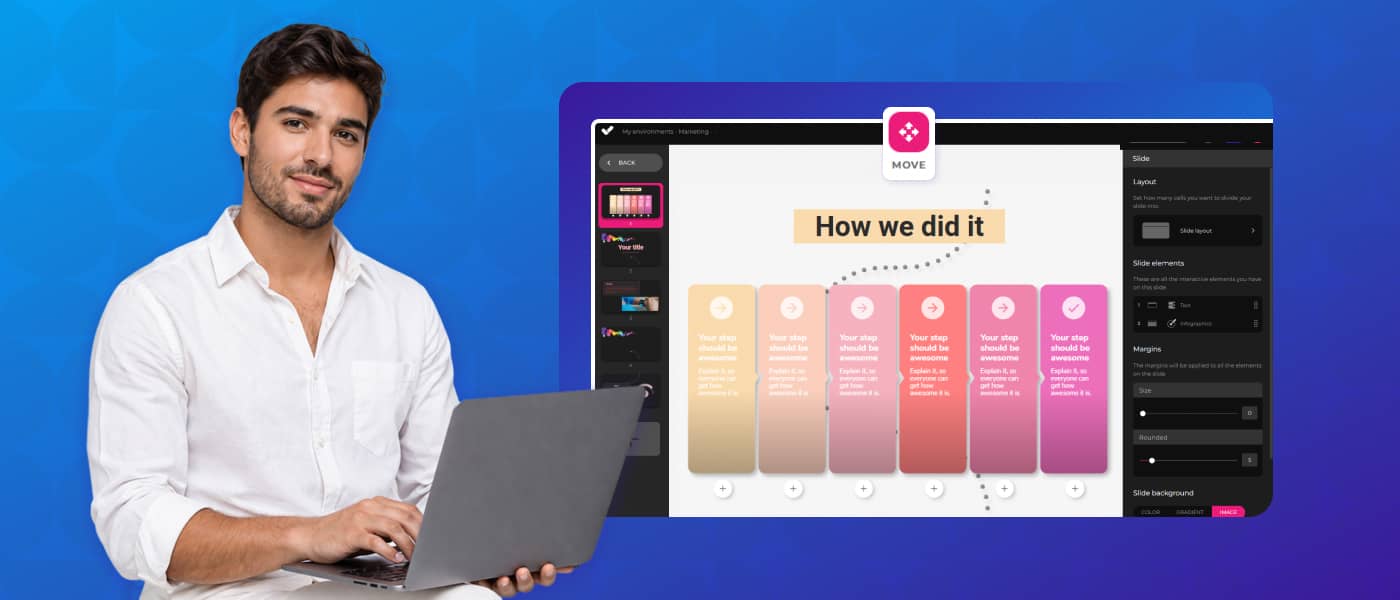
How to use AI in your authoring tool
Discover how artificial intelligence can become your main ally in the creation of your e-learning courses.
Watch recording


How can AI become your best ally for creating e-learning courses?
Discover isEazy Author's powerful AI features



How can AI become your best ally for creating e-learning courses?
Discover isEazy Author's powerful AI features
Related articles