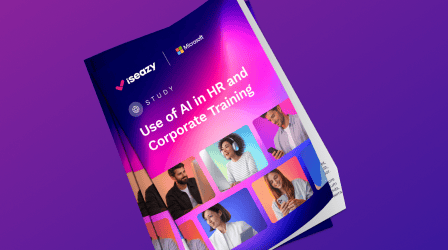
STUDY
Use of AI in HR and Corporate Training

Author
The #1 AI-powered authoring tool on the market

Factory
Custom e-learning content factory

Skills
Comprehensive power skills course catalog

LMS
All-in-one LMS platform with AI

Engage
App for managing frontline teams

Game
Gamification app for business
FEATURES

AINew
Unlock your full potential and speed up course creation with artificial intelligence.

Accessibility
Automatically meet accessibility guidelines—without sacrificing interactivity!

Interactivity
Boost engagement with interactive, ready-to-use activities that make learning fun.

Course Creation
Reduce the time it takes to create your e-learning courses with our authoring tool.

Distribution
We offer you different distribution options, so that nothing can stop you.

SCORM
Publish your course in SCORM format and share it on any LMS.
SERVICES

Instrucional Design
Surprise your students with multimedia and interactive content.

Custom Courses
We create e-learning courses for you—tailored to your needs and hassle-free!

Virtual Reality
Turn learning into an immersive experience.

Custom Avatars
Give your courses and videos a unique touch with personalized avatars.

Audiovisual FactoryNew
Turn training into something dynamic and visual with engaging videos.
CATALOG
Course catalog
Over 600 skills and competency courses to help you adapt to your team's needs.

Microsoft Copilot AcademyNew
Your professionals will learn how to apply Copilot AI to key processes within your organization.
Artificial Intelligence Academy
Train your teams in the practical use of AI to boost productivity and innovation in your company.

Cybersecurity Academy
Capacita a tu empresa con el catálogo más completo en seguridad digital corporativa.
FEATURES

Quizzes & Games
Turn your training into an engaging Q&A game.

Challenges & Competitions
Enhance learning through friendly peer challenges.
Rewards & Incentives
Motivate employees with points, levels, and leaderboards.
Social & Collaborative
Strengthen team connections with interactive social dynamics.

KPIs & Analytics
Track and optimize your training initiatives instantly and effortlessly.

Use cases
Choose the solution that best fits your needs

Industries
Solutions for all types of industries
USE CASES
Onboarding
Facilitate the onboarding process, productivity and engagement of your new employees.
Upskilling
Boost your team's skills and prepare them for the challenges of the future with upskilling.
Microlearning
Discover all the advantages of microlearning and boost your training results.
Gamification
Enjoy addictive training that will get your professionals hooked.

Internal Communication
Improve communication in your company and enjoy an aligned and committed team.

Mobile learning
Agile, flexible, and interactive learning—built for today’s digital-first workforce.
INDUSTRIES

Banking and financial services
Training in compliance, cybersecurity, customer service, and key skills development.

Pharmaceuticals and healthcare
Digital onboarding, regulatory updates, and ongoing training for healthcare staff.

Retail and consumer
Agile and scalable training for in-store, operational, and customer service teams.

Industry and manufacturing
Training in processes, safety, and corporate culture for distributed teams.

Education and training
Digital solutions for training centers, internal academies, and corporate universities.

Technology and telecommunications
Development of technical talent, digital skills, and upskilling and reskilling programs.
CLIENTS

MAPFRE
How MAPFRE turn e-learning into sales with isEazy

Pepco
A personalised learning experience for a growing team.

BBVA
Digitisation and creation of high quality e-learning content.

Shiseido
We increase the engagement of the training with a social and gamified app.

Telefónica
Large-scale reskilling for the company's digital transformation.

Vodafone
A personalised learning experience for a growing team.
More than 1,000 companies already rely on isEazy.




MEET ISEAZY

News
Find out the latest news about isEazy: press releases, partnerships, updates...

Contact
Leave us your personal details and we will contact you as soon as possible.
About isEazyNew
Find out more about our company.
Careers
We are looking for the best talent, join our team!

Partners
Become our partner and grow your business.
INTERESTING RESOURCES

Blog
The best content on e-learning: trends, tools and key strategies.
Whitepapers
Gain valuable insights and stay ahead of industry trends.
Product releases
The latest news and releases of our e-learning products and solutions.

Glossary
Definitions of the most commonly used terms and key industry concepts.
Guides
Discover the best step-by-step tips and tricks to optimize your L&D strategy.
Webinars
Video sessions on our products, trends and more

Comparatives
Compare e-learning solutions available on the market and choose the most suitable one.

STUDY
Download the free study, developed in collaboration with Microsoft, and discover the insights.

April 14, 2026

CONTENT CREATED BY:

Table of contents
Personnel recruitment is the process by which an organisation identifies, attracts, and builds a pool of qualified candidates to fill a vacancy. Its goal is not to choose the right person — that is the role of selection — but to ensure that the selection process has the largest possible pool of suitable candidates to choose from.
In the context of HR and L&D departments, effective recruitment does not end when the contract is signed: it is directly linked to the quality of onboarding and initial training, which determine talent retention in the medium and long term. According to the Brandon Hall Group, organisations with a structured onboarding process improve new employee retention by 82% and productivity by over 70%.
There are several recruitment models depending on the origin of candidates and the company’s strategy. Understanding them allows you to choose the most efficient approach for each type of vacancy:
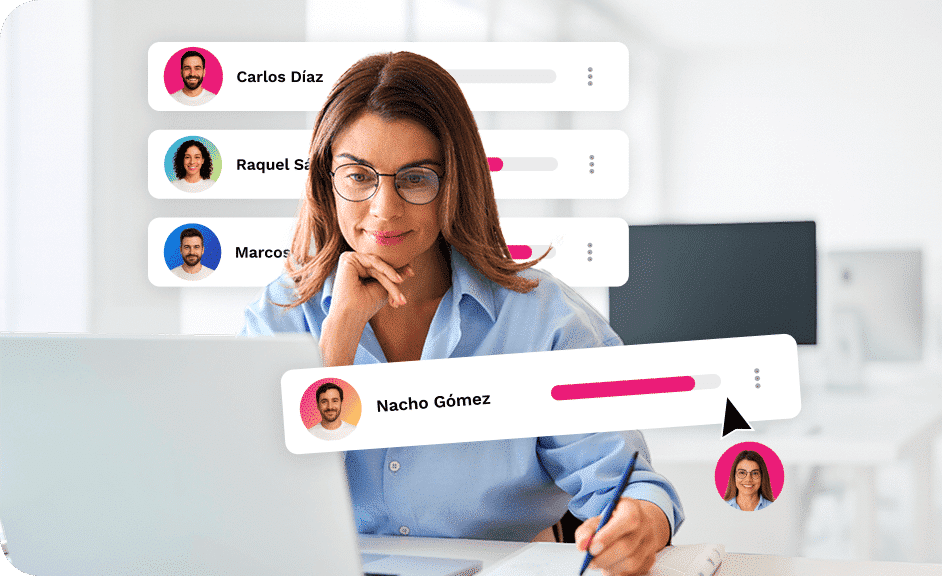
A well-structured recruitment process follows a logical sequence that goes from identifying the need to onboarding the candidate. These are the main stages:
The process begins when a vacancy is detected: due to team growth, a replacement, or the creation of a new role. At this stage, HR works with the relevant manager to determine whether the need requires a new hire or can be resolved through internal recruitment or reallocation of responsibilities.
A detailed job description is drafted: responsibilities, required competencies, experience level, educational background, and technical and soft skills. A well-defined profile prevents unsuitable applications and speeds up subsequent screening.
Based on the profile and available budget, the most efficient channel is selected: job portals (LinkedIn, Indeed, Infojobs), professional social networks, recruitment agencies, internal referral programmes, job fairs, or direct university outreach.
The job posting should be clear, compelling, and aligned with the company’s employer value proposition. A well-crafted advert filters out unsuitable candidates before screening even begins and improves the quality of applications received.
Once candidates have been received, screening begins: filtering by objective criteria, reviewing career history, initial phone contact, or applying basic competency tests. The goal is to reduce the volume to a group of candidates who will move on to the selection stage.
Recruitment concludes when a list of pre-qualified candidates — with all the information needed to proceed to in-depth interviews, technical tests, and final assessment — is handed over to the person responsible for selection.
Although frequently used interchangeably, recruitment and selection are two distinct and sequential processes. Understanding their differences is essential for allocating resources correctly and optimising each stage independently:
| Criterion | Recruitment | Personnel selection |
|---|---|---|
| Objective | Attract and build a candidate pool | Evaluate and choose the most suitable candidate |
| Nature | Expansive: seeks a quantity of qualified candidates | Restrictive: eliminates until the best profile is found |
| Key activities | Post vacancies, CV screening, initial screening calls | Interviews, technical tests, competency assessment |
| Output | Shortlist of pre-selected candidates | Candidate selected for the role |
| Typical duration | 1–3 weeks (depending on channel and profile) | 2–5 weeks (depending on role level) |
| Primary owner | Recruitment Specialist | HR Business Partner or hiring manager |
Digitalisation has radically transformed recruitment processes in recent years. These are the key technologies redefining how companies attract talent:
Candidate tracking systems allow you to manage the entire process from a single platform: posting vacancies across multiple channels, receiving and organising applications, automating communications, and tracking the status of each candidate. Tools such as Workday, Greenhouse, and BambooHR are market benchmarks.
AI algorithms analyse CVs and candidate profiles to predict job fit based on competencies, career history, and previous success patterns. They reduce manual screening time and minimise unconscious bias in pre-selection.
LinkedIn, Instagram, and other professional networks allow you to reach passive candidates — those not actively job-seeking but potentially open to the right opportunity. Social recruiting is particularly effective for technical profiles and leadership positions.
Asynchronous interview platforms (such as HireVue or Spark Hire) allow candidates to record video responses to preset questions before a live meeting, reducing process time and making it easier to screen high volumes of applicants.
Automation does not replace human judgement in hiring, but it does eliminate repetitive, low-value tasks that consume HR team time. Knowing where to apply it is key to gaining efficiency without compromising process quality.
What is worth automating:
What should NOT be fully automated:
STUDY
Use of AI in HR and Corporate Training
How AI is being used, what’s working, and what’s really holding back its adoption.
Download the study

Employer branding is a company’s reputation as a place to work. In an increasingly competitive talent market, organisations with a clear employee value proposition — culture, professional development, flexibility, purpose — attract higher-quality candidates with less investment in job advertising.
According to Mercer’s Global Talent Trends report, 51% of workers say they would change companies if offered better learning and development opportunities. This positions training and professional growth as one of the most powerful attraction factors, ahead of salary for certain profiles.
For HR and L&D, this has a direct implication: investing in robust training programmes, clear career paths, and a continuous learning culture is simultaneously a retention strategy and a talent attraction tool.
Successful recruitment does not end when the candidate signs the contract. The integration phase — onboarding — is the natural continuation of the process and one of the factors that most influences short and medium-term retention. According to the Brandon Hall Group, companies with a structured onboarding process retain 82% more employees during the first year and reach full productivity levels 70% faster.
The problem is that many organisations treat onboarding as an administrative formality — paperwork, system access, generic presentations — rather than a strategic learning process. The result is a high voluntary turnover rate within the first 6 months, which according to SHRM can represent up to 20% of new hires.
Effective onboarding includes: introduction to company culture and values, role-specific training, assignment of a mentor or buddy, clear 30/60/90-day objectives, and regular progress check-ins. Tools like isEazy Engage make it possible to digitalise and scale this process, delivering a consistent experience regardless of where the new employee is based.
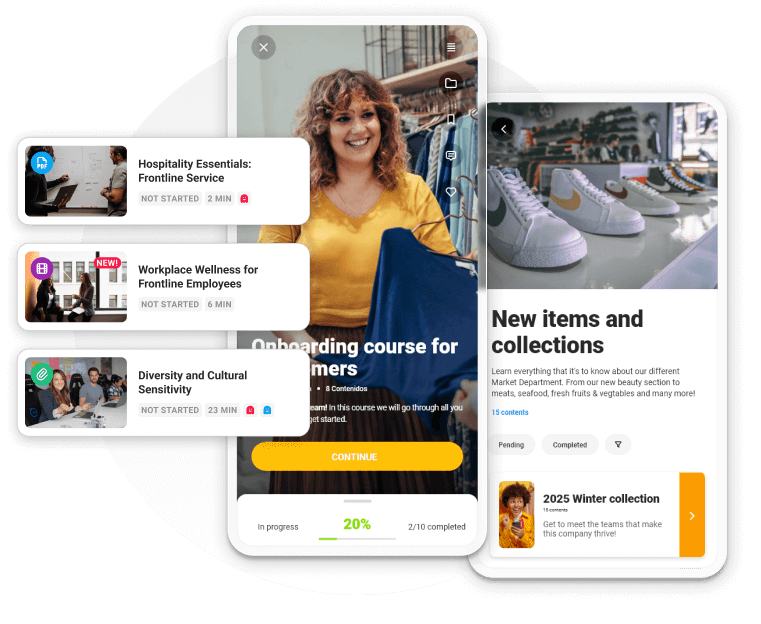
Bridgestone is a clear example of how mobile and gamified training can transform the integration and upskilling of an extensive distribution network. With isEazy, the company deployed a 100% mobile learning environment to train its Latin American distribution network, ensuring a consistent experience regardless of each employee’s geographical location. Find out how they did it →
Choosing the right tool to manage onboarding and initial training makes the difference between effective integration and a fragmented experience. Below is a comparison of the leading platforms on the market to help you make the best decision for your organisation:
Features
Advantages
Pricing
Flexible pricing model based on company needs. Plans tailored to the size of the organization and number of users.
Features
Advantages
Pricing
Flexible pricing model based on company needs. Plans tailored to the size of the organization and number of users.

Features
Advantages
Pricing
It is necessary to fill out a form to obtain pricing.
Features
Advantages
Pricing
It is necessary to fill out a form to obtain pricing.
Features
Benefits
Technology, compatibility and integration
Pricing
Features
Benefits
Technology, compatibility and integration
Pricing
Personnel recruitment is much more than posting a vacancy and waiting for applications. It is the first link in a chain that defines the quality of talent entering the organisation, how quickly that person integrates and becomes productive, and the likelihood of their staying long-term.
Companies that treat recruitment as a strategic process — with well-defined profiles, appropriate channels, technology that automates repetitive tasks, and a solid employer value proposition — have a real advantage over those that approach it reactively.
And those that also connect recruitment to structured onboarding and a continuous learning culture close the loop: they attract better talent, integrate it faster, and retain it longer. In that complete cycle, training and engagement tools play a central role — and that is exactly where solutions like isEazy Engage make the difference.
Recruitment is the process of attracting candidates to fill a vacancy: posting job offers, identifying talent, and building a candidate pool. Personnel selection begins where recruitment ends: it evaluates those candidates through tests, interviews, and assessments to choose the most suitable one. In short, recruitment is expansive (seeks quantity), while selection is restrictive (seeks quality). Both processes are complementary and together form the complete talent acquisition cycle in the organisation.
The average duration of a recruitment process ranges from 2 to 8 weeks, although it varies depending on the sector, role level, and profile complexity. For technical or leadership positions, the process can extend to 3 or 4 months. According to the SHRM (Society for Human Resource Management), the average time-to-hire at mid-sized companies is 36 days. Factors such as using an ATS, automating CV screening, or having an active talent database can significantly reduce this timeframe.
Recruitment 3.0 or digital recruitment refers to the set of strategies and technologies that enable companies to attract and manage candidates through digital channels: social networks, online job portals, ATS (Applicant Tracking Systems), artificial intelligence for automatic CV screening, and matching algorithms. Unlike traditional recruitment — based on print advertising and manual application management — digital recruitment reduces timelines, broadens geographic reach, and enables data-driven decisions about candidates.
The key metrics for measuring recruitment success include: time-to-hire, cost-per-hire, 90-day and one-year retention rates, quality of the selected candidate (assessed during the probationary period), and candidate Net Promoter Score (experience throughout the process). A frequently overlooked aspect is measuring the success of subsequent onboarding: if a new employee leaves within the first 6 months, the issue may lie in either the selection process or the integration and initial training — not just the hire itself.

Discover how to train, communicate, and support your professionals from day one, no matter where they are!
Request a demo


Only 12% of workers are satisfied with their onboarding process
Avoid first-day frustration and take engagement, productivity, and retention to the next level with an onboarding app

Only 12% of workers are satisfied with their onboarding process
Avoid first-day frustration and take engagement, productivity, and retention to the next level with an onboarding app