STUDY
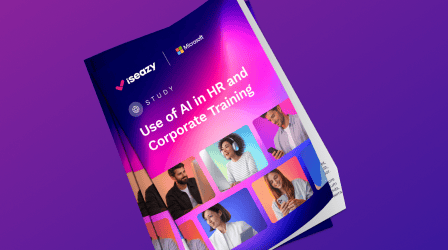
Use of AI in HR and Corporate Training

Author
The #1 AI-powered authoring tool on the market

Factory
Custom e-learning content factory

Skills
Comprehensive power skills course catalog

LMS
All-in-one LMS platform with AI

Engage
App for managing frontline teams

Game
Gamification app for business
FEATURES

AINew
Unlock your full potential and speed up course creation with artificial intelligence.

Accessibility
Automatically meet accessibility guidelines—without sacrificing interactivity!

Interactivity
Boost engagement with interactive, ready-to-use activities that make learning fun.

Course Creation
Reduce the time it takes to create your e-learning courses with our authoring tool.

Distribution
We offer you different distribution options, so that nothing can stop you.

SCORM
Publish your course in SCORM format and share it on any LMS.
SERVICES

Instrucional Design
Surprise your students with multimedia and interactive content.

Custom Courses
We create e-learning courses for you—tailored to your needs and hassle-free!

Virtual Reality
Turn learning into an immersive experience.

Custom Avatars
Give your courses and videos a unique touch with personalized avatars.

Audiovisual FactoryNew
Turn training into something dynamic and visual with engaging videos.
CATALOG
Course catalog
Over 600 skills and competency courses to help you adapt to your team's needs.

Microsoft Copilot AcademyNew
Your professionals will learn how to apply Copilot AI to key processes within your organization.
Artificial Intelligence Academy
Train your teams in the practical use of AI to boost productivity and innovation in your company.

Cybersecurity Academy
Capacita a tu empresa con el catálogo más completo en seguridad digital corporativa.
FEATURES

Quizzes & Games
Turn your training into an engaging Q&A game.

Challenges & Competitions
Enhance learning through friendly peer challenges.
Rewards & Incentives
Motivate employees with points, levels, and leaderboards.
Social & Collaborative
Strengthen team connections with interactive social dynamics.

KPIs & Analytics
Track and optimize your training initiatives instantly and effortlessly.

Use cases
Choose the solution that best fits your needs

Industries
Solutions for all types of industries
USE CASES
Onboarding
Facilitate the onboarding process, productivity and engagement of your new employees.
Upskilling
Boost your team's skills and prepare them for the challenges of the future with upskilling.
Microlearning
Discover all the advantages of microlearning and boost your training results.
Gamification
Enjoy addictive training that will get your professionals hooked.

Internal Communication
Improve communication in your company and enjoy an aligned and committed team.

Mobile learning
Agile, flexible, and interactive learning—built for today’s digital-first workforce.
INDUSTRIES

Banking and financial services
Training in compliance, cybersecurity, customer service, and key skills development.

Pharmaceuticals and healthcare
Digital onboarding, regulatory updates, and ongoing training for healthcare staff.

Retail and consumer
Agile and scalable training for in-store, operational, and customer service teams.

Industry and manufacturing
Training in processes, safety, and corporate culture for distributed teams.

Education and training
Digital solutions for training centers, internal academies, and corporate universities.

Technology and telecommunications
Development of technical talent, digital skills, and upskilling and reskilling programs.
CLIENTS

MAPFRE
How MAPFRE turn e-learning into sales with isEazy

Pepco
A personalised learning experience for a growing team.

BBVA
Digitisation and creation of high quality e-learning content.

Shiseido
We increase the engagement of the training with a social and gamified app.

Telefónica
Large-scale reskilling for the company's digital transformation.

Vodafone
A personalised learning experience for a growing team.
More than 1,000 companies already rely on isEazy.





MEET ISEAZY

News
Find out the latest news about isEazy: press releases, partnerships, updates...

Contact
Leave us your personal details and we will contact you as soon as possible.
About isEazyNew
Find out more about our company.
Careers
We are looking for the best talent, join our team!

Partners
Become our partner and grow your business.
INTERESTING RESOURCES

Blog
The best content on e-learning: trends, tools and key strategies.
Whitepapers
Gain valuable insights and stay ahead of industry trends.
Product releases
The latest news and releases of our e-learning products and solutions.

Glossary
Definitions of the most commonly used terms and key industry concepts.
Guides
Discover the best step-by-step tips and tricks to optimize your L&D strategy.
Webinars
Video sessions on our products, trends and more

Comparatives
Compare e-learning solutions available on the market and choose the most suitable one.

STUDY
Download the free study, developed in collaboration with Microsoft, and discover the insights.

April 6, 2026

CONTENT CREATED BY:

Table of contents
Picture this. A training manager completes an online course on artificial intelligence. An hour and a half. Certificate included. They go back to their desk, open ChatGPT, and sit there staring at the screen with no idea what to ask it or how.
This scene is playing out in thousands of organisations. And the data confirms it.
That is the finding of the study on AI in HR and L&D that we produced alongside Microsoft, with the participation of more than 300 professionals from 32 countries.
The takeaway? More than half of organisations are investing in AI training that simply isn’t working. And the most striking thing is that almost nobody is saying it out loud.
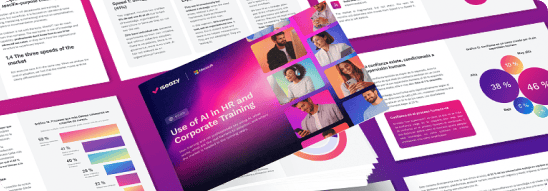
STUDY
Use of AI in HR and Corporate Training
How AI is being used, what’s working, and what’s really holding back its adoption.
Download the study

When you analyse why real AI adoption remains so limited —only 23% of the market has achieved genuine integration into its processes— the answer that emerges isn’t a lack of tools or budget. It’s a lack of applied knowledge.
And here lies the paradox the study uncovers: companies are training, but they’re not transforming.
Why? Because AI training being rolled out in most organisations today has three structural problems:
The result is predictable: professionals who have “done an AI course” but still don’t know how to integrate it into their real workflow. The course happened. The change did not.
The study reveals one of the most compelling correlations in the entire research: professionals with a high level of AI knowledge have an advanced adoption rate of 76%. Those with a low level: just 6%.
There is no shortcut. There is no way to reach genuine integration without going through genuine knowledge. And genuine knowledge doesn’t come from a ninety-minute webinar on the future of artificial intelligence.
What the study also shows is that when training works, the results are dramatically different. Organisations that offer mandatory, practical training have achieved real integration in 39% of cases, compared to 12% among those that offer no training at all. Three times more. Simply by doing well what others do poorly.
There is something deeply ironic about all this that deserves to be said. L&D and HR departments have spent decades designing learning experiences for others. They know better than anyone the difference between training that transforms and training that merely logs hours. They know that learning without practical application is forgotten within 72 hours. They know that role-based personalisation multiplies transfer to the job.
And yet, when it comes to training themselves in AI, they are receiving exactly the kind of training they would never design for their own employees: Generic. Theoretical. Fragmented.
The study data is quite clear about what distinguishes training that moves the needle from training that doesn’t:
That is precisely what isEazy has built together with Microsoft in the Microsoft Copilot School: a training catalogue designed specifically so that teams learn to apply Copilot AI in their organisation’s strategic processes. With general courses, specialist modules by tool — Word, Excel, PowerPoint, Outlook, Teams — and learning paths adapted by professional profile: HR, Marketing, Sales, Operations, Finance.
MICROSOFT COPILOT ACADEMY
Turn Copilot's AI into a real competitive advantage for all areas of your business


Practical training, with real use cases, endorsed by Microsoft and with dual accreditation. On one hand, official Microsoft diplomas and badges issued through Microsoft Learn. On the other, isEazy Skills certificates that can be shared directly on LinkedIn.
Because the difference between knowing Copilot exists and knowing how to use it to transform the way your team works is exactly the same as the difference between that 6% and that 76% the data talks about. Which side is your team on?
Most companies are offering AI training, but the courses tend to be too generic, theoretical, and fragmented. This means that while employees go through the courses, they don’t know how to integrate AI into their daily tasks. For training to be effective, it must be specific, practical, and aligned with the organization’s real workflows.
The training that truly transforms employees is the one designed for role-specific use cases within the company. Additionally, it needs to be practical from the first module, teaching employees how to use AI in their everyday tasks, rather than just explaining what AI is.
isEazy has developed a training catalog in collaboration with Microsoft, specifically designed to help teams apply Copilot AI in their organizational processes. The courses include tool-specific modules (such as Word, Excel, PowerPoint, Teams) and are tailored to different professional profiles like HR, Marketing, Sales, and more.
Practical, role-specific training allows employees to integrate AI directly into their workflows, leading to faster and more effective adoption. According to the study, organizations offering practical training have achieved a real adoption rate of 39%, much higher than those that don’t offer training or offer it in a theoretical format.

So you can get it with just one click.
Download the study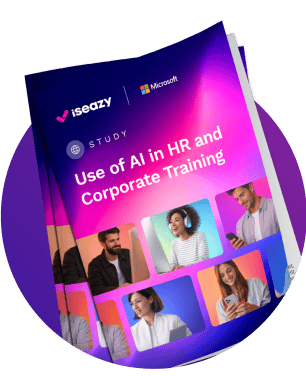

Discover the Microsoft Copilot Academy
A training catalog created by experts and endorsed by Microsoft, so your teams can turn Copilot AI into a real competitive advantage for all areas of your business.


Discover the Microsoft Copilot Academy
A training catalog created by experts and endorsed by Microsoft, so your teams can turn Copilot AI into a real competitive advantage for all areas of your business.